
Unequally Yoked
- Justin Ray

- May 24, 2020
- 6 min read
Ezra 7-10
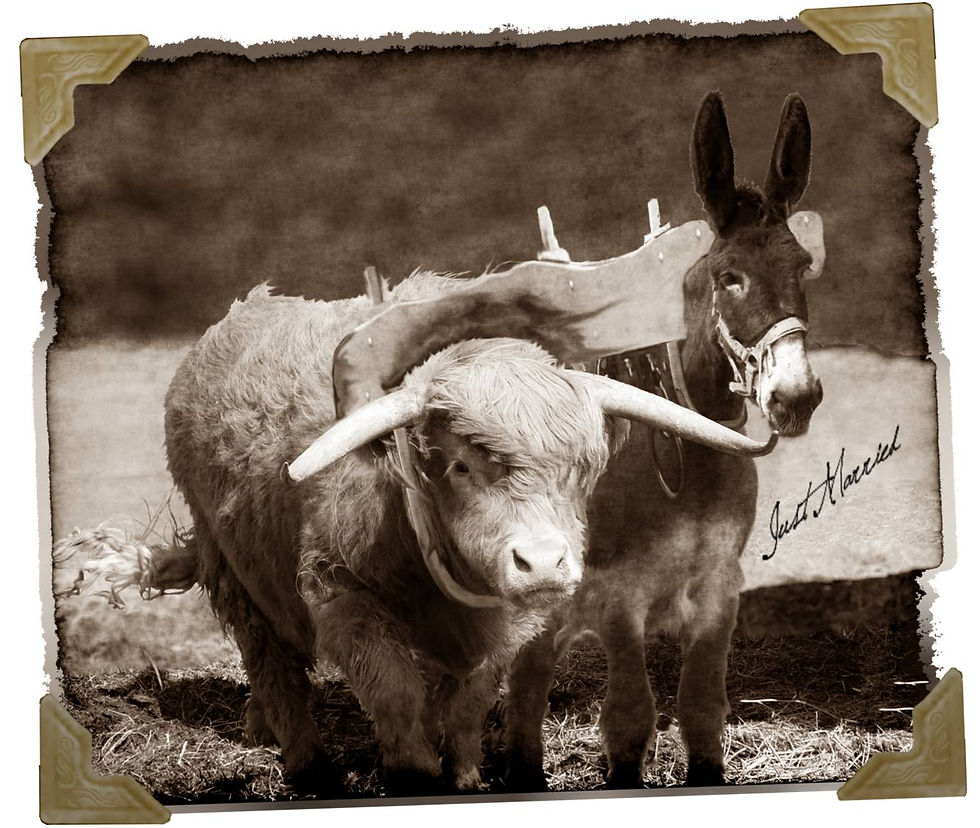
Even without any knowledge of farming, this picture just doesn't look right (not talking about the "Just married script" on the side). Just looking at the picture, the ox and the donkey just don't fit together. The yoke (wood beam connecting them at their necks) is unbalanced. They will not be pulling together. Either they will pull against one another, or one will pull far more than the other. They will not work together.
What does this have to do with today's reading? The answer is Everything! While the phrase "unequally yoked" does not appear in our reading, the idea is very much there. That term actually comes from Paul's second letter to the church at Corinth.
Be ye not unequally yoked together with unbelievers: for what fellowship hath righteousness with unrighteousness? and what communion hath light with darkness?
II Corinthians 6:14
To see what II Corinthians 6:14 has to do with Ezra, we need to look at the last two chapters of Ezra. Here are the first two verses to get us started.
Now when these things were done, the princes came to me, saying, The people of Israel, and the priests, and the Levites, have not separated themselves from the people of the lands, doing according to their abominations, even of the Canaanites, the Hittites, the Perizzites, the Jebusites, the Ammonites, the Moabites, the Egyptians, and the Amorites. 2 For they have taken of their daughters for themselves, and for their sons: so that the holy seed have mingled themselves with the people of those lands: yea, the hand of the princes and rulers hath been chief in this trespass.
Ezra 9:1-2
Just reading this, even if you find it a little confusing, you can tell that whatever they did was not good. Words like "not separated from the people of the land" and "abominations" let us know this is not good. So, what happened? The Jews that returned from Babylonian/Persian captivity decided to marry some of the local girls that had been transplanted into Judah and Israel when they Jews were taken out. When Nebuchadnezzar captured Judah, the Jews did not appreciate being under his rule. So, they showed out. King Neb would have none of this, so he scattered the Jews all over his kingdom. Then, he moved other people from his kingdom to Judah and Jerusalem. The idea was they couldn't conspire to rebel if they were scattered all over the empire.
So, over the years of rebuilding the Temple, the Jewish men decided that all these women looked good. So, they married them, or allowed their sons to marry them. This sounds OK, except that God forbid it.
When the LORD thy God shall bring thee into the land whither thou goest to possess it, and hath cast out many nations before thee, the Hittites, and the Girgashites, and the Amorites, and the Canaanites, and the Perizzites, and the Hivites, and the Jebusites, seven nations greater and mightier than thou; 2 And when the LORD thy God shall deliver them before thee; thou shalt smite them, and utterly destroy them; thou shalt make no covenant with them, nor shew mercy unto them: 3 Neither shalt thou make marriages with them; thy daughter thou shalt not give unto his son, nor his daughter shalt thou take unto thy son.
Deuteronomy 7:1-3
When we compare the lists from Deuteronomy and Ezra, some of the names are the same, and some are not. However, we have to look beyond lists to the heart of what God was saying. He was basically saying, "I am bringing you into a land. A land I have promised you. Don't marry the locals who worship idols and defile yourself. Instead of blessing you, like I want to do, I will curse you because they will turn your hearts away from me." Ezra and Joshua are a lot alike. They both led the children of Israel into a land that had been promised to them by God. Both were leading the people in after they had spent a period of time being punished for rebelling against God. And, both had to deal with people not doing what God had instructed them to do (or doing what he told them not to do).
So, what was Ezra's response to learning that the people were marrying the local pagans?
And when I heard this thing, I rent my garment and my mantle, and plucked off the hair of my head and of my beard, and sat down astonied. 4 Then were assembled unto me every one that trembled at the words of the God of Israel, because of the transgression of those that had been carried away; and I sat astonied until the evening sacrifice. 5 And at the evening sacrifice I arose up from my heaviness; and having rent my garment and my mantle, I fell upon my knees, and spread out my hands unto the LORD my God
Ezra 9:3-5
From our western way of thinking, this seems extreme, but maybe it shouldn't. Ezra was REALLY upset by what he heard and he mourned. This was far less about nationalism, and far more about holiness. Not to mention, they had just spent 70 years in captivity for doing this very thing! They had married pagans, worked with pagans, and then began worshiping the pagan's gods. For that, God allowed Assyria and Babylon to take them into captivity. Now, they were just getting settled back at home and some of the people were doing the exact same things that got them in trouble in the first place.
Not only was Ezra upset, but he held a prayer meeting. Ezra recorded, "then were assembled unto me every one that trembled at the words of the God of Israel." They mourned together, they sacrificed together, and they prayed together. This was a big deal! They wanted both God's forgiveness and guidance on how to handle this mess.
Now when Ezra had prayed, and when he had confessed, weeping and casting himself down before the house of God, there assembled unto him out of Israel a very great congregation of men and women and children: for the people wept very sore. 2 And Shechaniah the son of Jehiel, one of the sons of Elam, answered and said unto Ezra, We have trespassed against our God, and have taken strange wives of the people of the land: yet now there is hope in Israel concerning this thing. 3 Now therefore let us make a covenant with our God to put away all the wives, and such as are born of them, according to the counsel of my lord, and of those that tremble at the commandment of our God; and let it be done according to the law.
Ezra 10:1-3
After the prayer for forgiveness and guidance, they had their solution. Those who married the pagan women had to divorce them and send them away. Not only did the women have to go, but any children that they had by the women. This sounds extreme, but that is what is required by holiness. Had they not been disobedient in the first place, there would not have been these measures to take. If the holiness and righteousness of God demands death for sin, this is a less "extreme" consequence for their disobedience. Understand, their sins led to their consequences. God did not make them marry a pagan, that was their choice. They knew better but decided to do what they wanted anyway.
God is serious about holiness. Holiness is who God is. He calls us to be holy as he is holy (Exodus 19:6, I Peter 1:16). God was so serious about this that he led Ezra to include the names of everyone who had married a pagan women. For all eternity, their names are recorded in the scriptures as those who rebelled. It is almost as though Ezra was pointing his finger at them and saying, "These are the ones who almost messed everything up for us again!"
We too should be careful who influences us. A spouse certainly influences us! When we see that someone around us being influenced by a sinful person, we need to take the same action as Ezra. We should mourn, because sin is serious. We should ask Christians to pray with us for forgiveness and guidance. We should be ready to take the action God leads us to do. It probably won't be fun, but it will be best. It is better to suffer the consequences of dealing with sin, than the death that sin itself brings!
Father, I pray that you would help me to care more about holiness than sinful desires. Help me to turn away from sin, rather than pursue it. When I see others being influenced by sinners, I pray that my heart would be burdened like Ezra's. Help me to run to you, pray for forgiveness and wisdom, and be bold to take the action that you lead in.


Comments