
A House Divided
- Justin Ray

- Apr 17, 2020
- 5 min read
I Kings 12-13
There is not a lot of encouragement in these two chapters. In our last reading, Solomon died. He died serving false gods. Now, his son Rehoboam sits on the throne. Chapter 12 gives us his first recorded challenge, which would change the face of Israel for centuries to come.
David and Solomon had been kingdom builders. David built through combat and conquest. Solomon built through diplomacy, taxation, and infrastructure. After 80 years of hard labor, the people were tired. So, their first request to Rehoboam was a tax cut. They asked him to lighten their load.
4. Thy father made our yoke grievous: now therefore make thou the grievous service of thy father, and his heavy yoke which he put upon us, lighter, and we will serve thee.
As any good leader should do, Rehoboam consults his advisers. He first goes to the elders that served with his father. These were men that had served under the wisest king to ever live. They advised Rehoboam that if he listened to the people, and served them, they would serve him.
Then Rehoboam consulted his friends. When I first started preaching, my dad told me, if you want to learn how to pastor, LISTEN to older pastors. Young pastors know just as much as you do, but older pastors have been there and done that. Someone should have given Rehoboam that advice, or rather he should have listened when he was given that advice.
Job 12:12 With the ancient is wisdom; and in length of days understanding.
Rehoboam listened to the advice of his friends and instead of giving the people relief from their years of hard service, said that he was going to be a more severe ruler than his father. When the people heard this, they said, "What portion have we in David? Neither have we inheritance in the son of Jesse: To your tents, O Israel: Now see to thine own house, David" (verse 16). In other words, you are not our family and we are not part of your inheritance. Rule your own house. We will no longer serve you.
Rehoboam tried to tax them but they killed his tax collector. At that point Rehoboam realized that the people were serious and ran back home. He gathered his army to try to force them back into service but God sent word to him and stopped him. God said that this was of Him. Remember, at the end of chapter 11, God told Solomon that this would happen. Because Solomon worshiped idols, God said he would divide the kingdom during the reign of his son. Once again, what God has said was done.
In chapter 13, we read about the establishment of Israel. The northern 10 tribes took the name Israel, while the southern 2 tribes took the name Judah. Jeroboam led in the rebellion against Rehoboam and now they have made him king. To make sure that they people did not return to Jerusalem to serve God, and realize that they should still be one nation, Jeroboam built his own capital, with his own temple, and his own gods. Then, he established his own sacrifice and feast days.
This did not please God and he sent a prophet to speak against Jeroboam. The prophet said that as a sign that his words were true, the altar would be split in two and the ashes would pour out of it. Jeroboam reached down and touched his altar and it split in half and the ashes poured out, just like the prophet said. Also, Jeroboam's hand "dried up", and he couldn't bring it back to his side. The prophet healed him, after Jeroboam asked him to pray for him.
Jeroboam asked the prophet to come eat with him in his home. The prophet said no, that God had told him to neither eat or drink while in Israel (the prophet was from Judah). The prophet leaves to return home. Word reaches a prophet who lives in Israel about this man and what he did to the Altar of Jeroboam. He goes out to meet him and asks him to come to his home and eat with him. The prophet of Judah tells that prophet of Israel the same thing he told Jeroboam. However, the prophet from Israel lies and says that God has spoken to him and told him to minister to the Prophet from Judah.
The prophet from Judah goes home with the man and eats. Immediately, God speaks through the prophet from Israel and condemns the prophet from Judah for his disobedience. As a result, the prophet from Judah will die. The prophet form Judah leaves the house to go home. On his journey, he is killed by a lion. The prophet from Israel hears of this and goes to get his body. He then buries the prophets body at his own expense.
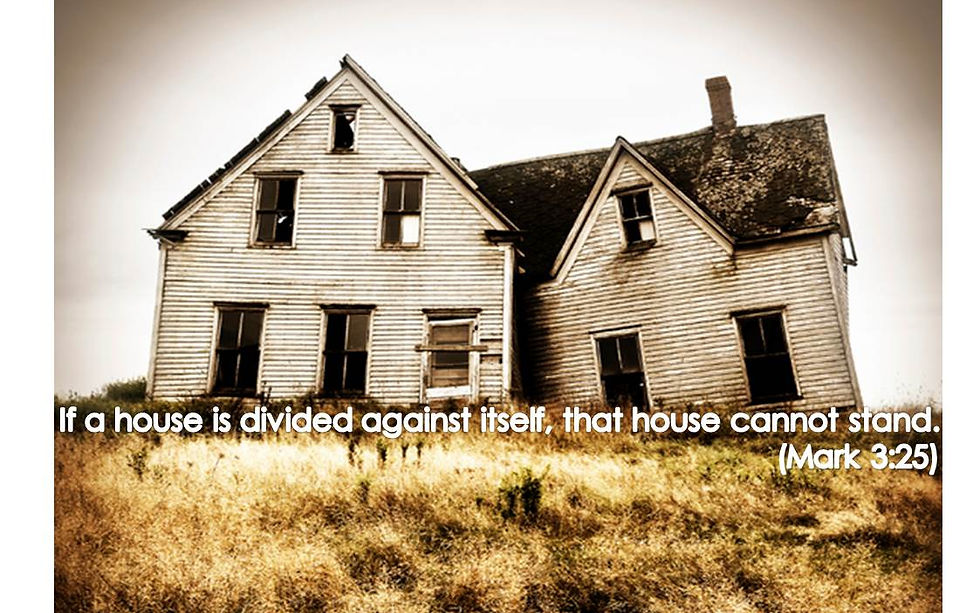
The title "A House Divided" fits both of these stories. First we see the "House" of Israel divided into two different kingdoms. Then, we see the "House" of the Prophets divided in deception. God gave clear instruction in both cases. For Rehoboam, the instruction came through wise counsel of elders. For the prophet from Judah, the instruction came directly from God. In both cases, the men listened to the counsel of others over God. In both cases, destruction came. The nation of Israel would never be what it had been. The prophet lost his life.
How often does this happen to us? We know what God's word says, but we do what we want instead. When I worked at the prison, I REALLY wanted to be on the CERT Team. I had prayed for this job and I had talked to my wife about it. I prayed "God if this is your will, let me have this job." My wife told me I didn't need to be on that team because of what the job entailed. She said that was not a job for a preacher. Ten applications (and prayers) later, God gave me what I wanted. I really liked my teammates but the job kept me in a dark place. Constant violence and chaos surrounded me. Finally, after God sidelined me with a knee surgery (job related injury), I realized that my wife's counsel was right. Not long after that, I left the prison system all together. However, I still deal with consequences for my disobedience and persistence in going against God's will.
In both Rehoboam and the prophets stories (as well as mine), there was clear instruction from God. His will was not obscure. Yet, in all of cases, God's will was ignored for the will of men. Yes, there were bad advisers in both cases, but the men knew what they were supposed to do. When we rebel against God, there is a price to pay. This is not because God is mean or vindictive about not getting his way, but because his way is there to keep us safe. When he says "don't", it is because he wants to protect us from what happens if we "do".


Comments